Sister Mary the Born Again Virgin
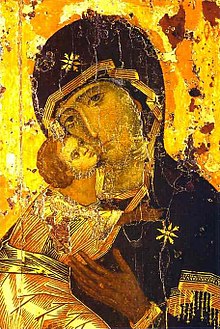
The Vladimir Eleusa icon of the E'er Virgin Mary. The Aeiparthenos (Ever Virgin) title is widely used in Orthodox liturgy, and icons evidence her with iii stars, on shoulders and brow, symbolising her threefold virginity.[1]
The perpetual virginity of Mary is ane of the four Marian dogmas of the Catholic Church building,[ii] and states that Mary, the female parent of Jesus, was a virgin ante partum, in partu, et postal service partum—before, during and after the birth of Christ.[3] In Western Christianity, the Catholic Church, some Lutheran, Reformed, Anglican and a few other Protestant theologians attach to the doctrine;[4] [5] [6] [7] [8] Shenouda 3, Pope of the Coptic Orthodox Church, affirmed the teaching;[ix] Eastern Orthodox churches recognize Mary equally Aeiparthenos , meaning "ever-virgin".[10] Mod Protestants have largely rejected the doctrine.[11]
The tradition of the perpetual virginity of Mary first appears in a tardily second century text chosen the Gospel of James.[12] It was established every bit orthodoxy at the Quango of Ephesus in 431,[13] the Second Council of Constantinople in 553 gave her the title "Aeiparthenos", meaning Perpetual Virgin, and at the Lateran Synod of 649 Pope Martin I emphasised the threefold character of the perpetual virginity, before, during, and after the birth of Christ.[14]
The New Testament explicitly affirms her virginity only prior to the conception of Jesus and mentions the brothers (adelphoi) of Jesus.[15] [sixteen] This word only very rarely means other than a physical or spiritual sibling, and they may take been: (one) the sons of Mary, the mother of Jesus, and Joseph (the well-nigh natural inference); (2) sons of the Mary named in Mark 15:forty every bit "mother of James and Joses", whom Jerome identified as a sister of Mary the mother of Christ; or (3) sons of Joseph past a former marriage.[17]
Origin and history [edit]
First appearance: 2nd century [edit]
Mary'southward pre-birth virginity is attested in the Gospel of Matthew and in the Gospel of Luke, but at that place is no biblical basis for the thought of her perpetual virginity.[18] This first appears in a late 2nd century text called the Protoevangelium of James,[12] in which Mary remains a life-long virgin, Joseph is an quondam human being who marries her without physical want, and the brothers of Jesus are explained as Joseph's sons by an before marriage.[19] The Protoevangelium seems to have been used to create the stories of Mary which are found in the Quran,[20] just while Muslims agree with Christians that Mary was a virgin at the moment of the formulation of Jesus, the idea of her perpetual virginity thereafter is reverse to the Islamic ideal of women as wives and mothers.[21]
Early uncertainty: 3rd century [edit]
In the 3rd century, Hippolytus of Rome held that Mary was "ever-virgin",[22] while Clement of Alexandria, writing soon after the Protoevangelium appeared, appealed to its incident of a midwife who examined Mary immediately after the nascency ("afterwards giving birth, she was examined by a midwife, who found her to exist a virgin") and asserted that this was to be found in the Gospels ("These things are attested to by the Scriptures of the Lord"), though he was referring to an apocryphal Gospel equally a fact, and the 3rd century scholar Origen used the Protoevangelium'due south explanation of the brothers to uphold the perpetual virginity of Mary ("There is no child of Mary except Jesus, co-ordinate to those who think correctly nearly her").[23] Tertullian, who came between Clement and Origen, denied Mary's perpetual virginity in order to refute the docetist idea that the Son of God could non have assumed a human body ("although she was a virgin when she conceived, she was a wife when she brought forth her son").[24]
Helvidius also argued that Victorinus believed that Mary had other children.[25] Still Jerome claimed that he was misinterpreting Victorinus.[26] Epiphanus invented a proper name "Antidicomarians" for a group of people who denied the perpetual virginity of Mary, which Epiphanus attacked.[27] They were active from the tertiary to the 5th century.[28]
Establishment of orthodoxy: 4th century [edit]
Past the early on 4th century the spread of monasticism had promoted celibacy every bit the ideal state,[29] and a moral hierarchy was established with marriage occupying the 3rd rank beneath life-long virginity and widowhood[30] Eastern theologians generally accepted Mary equally Aeiparthenos, but many in the Western church were less convinced.[31] The theologian Helvidius objected to the devaluation of marriage inherent in this view and argued that the two states, of virginity and marriage, were equal.[32] His contemporary Jerome, realising that this would lead to the Mother of God occupying a lower place in sky than virgins and widows, defended her perpetual virginity in his immensely influential Against Helvidius, issued c.383.[33]
Helvidius before long faded from the scene, but in the 380s and 390s the monk Jovinian followed him in denying Mary's perpetual virginity, writing that if Jesus did not undergo a normal human birth then he himself was not human, which was the teaching of the heresy known as Manicheism.[34] Jerome wrote against Jovinian only failed to mention this aspect of his teaching, and near commentators believe that he did not find it offensive.[34] The only important Christian intellectual to defend Mary's virginity in partu was Ambrose, Archbishop of Milan, who was the chief target of the charge of Manicheism.[35] For Ambrose, both the physical birth of Jesus by Mary and the baptismal birthing of Christians past the church had to be totally virginal, even in partu, in order to cancel the stain of original sin, of which the pains of labor are the physical sign.[36] It was due to Ambrose that virginitas in partu came to be included consistently in the thinking of subsequent theologians.[37] Bonosus of Sardica also denied the perpetual virginity of Mary, for which he was declared a heretic.[38] [39]
Jovinian was condemned equally a heretic at a Synod of Milan nether Ambrose'southward presidency in 390 and Mary's perpetual virginity was established every bit the only orthodox view,[14] although information technology was non until the Quango of Ephesus in 431 that a fully full general consensus was established.[thirteen] Further developments were to follow when the 2d Council of Constantinople in 553 formally gave her the championship "Aeiparthenos", and at the Lateran Synod of 649 Pope Martin I emphasised the threefold grapheme of the perpetual virginity, before, during, and after the nativity of Christ.[14]
Athanasius of Alexandria (d.393) declared Mary Aeiparthenos, "ever-virgin", and the liturgy of James the blood brother of Jesus too required a proclamation of Mary every bit ever-virgin.[40]
Protestant Reformation [edit]
The Protestant Reformation saw a rejection of the sanctity of virginity, and as a result marriage and parenthood were extolled, Mary and Joseph were seen every bit a normal married couple, and sexual abstinence was no longer regarded as a virtue.[41] It also brought with it the idea of the Bible as the fundamental source of authority regarding God's word (sola scriptura),[42] and the reformers noted that while holy scripture explicitly required belief in the virgin birth, it only permitted the acceptance of perpetual virginity.[43] It was supported past Martin Luther (who names her ever-virgin in the Smalcald Manufactures, a Lutheran confession of organized religion written in 1537).[44], Huldrych Zwingli, Thomas Cranmer, John Wycliffe and later Protestant leaders including John Wesley, the co-founder of Methodism.[11] [45] [46] The view of John Calvin was more ambiguous, and he believed that we cannot know what happened to Mary later the birth of Jesus.[45]This was because these moderate reformers were nether pressure from others more radical than themselves who held Jesus to have been no more than than a prophet: Mary's perpetual virginity thus became a guarantee of the Incarnation of Christ, despite its shaky scriptural foundations.[47] Notwithstanding the acceptance of the earliest reformers, modern Protestants have largely rejected the perpetual virginity of Mary and it has rarely appeared explicitly in confessions or doctrinal statements.[48]
Doctrine [edit]
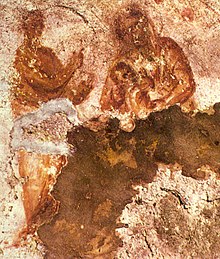
The Second Council of Constantinople recognised Mary as Aeiparthenos, meaning "ever-virgin".[10] It remains axiomatic for the Eastern Orthodox Church that she remained virginal throughout her Earthly life, and Orthodoxy therefore understands the New Attestation references to the brothers and sisters of Jesus as signifying his kin, only not the biological children of his mother.[49]
The Latin Church, known more than commonly today equally the Catholic Church building, shared the Council of Constantinople with the theologians of the Greek or Orthodox communion, and therefore shares with them the championship Aeiparthenos as accorded to Mary. The Catholic Church has gone further than the Orthodox in making the Perpetual Virginity ane of the four Marian dogmas, meaning that it is held to be a truth divinely revealed, the denial of which is heresy.[2] It declares her virginity earlier, during and after the birth of Jesus,[50] or in the definition formulated by Pope Martin I at the Lateran Quango of 649:[51]
The blessed ever-virginal and immaculate Mary conceived, without seed, past the Holy Spirit, and without loss of integrity brought him along, and after his nascence preserved her virginity inviolate.
Thomas Aquinas admitted that reason could non prove this, but argued that it must be accepted because it was "plumbing equipment",[52] for every bit Jesus was the only-begotten son of God, and so he should besides be the only-begotten son of Mary, as a second and purely human conception would disrespect the sacred country of her holy womb.[53] Symbolically, the perpetual virginity of Mary signifies a new creation and a fresh outset in conservancy history.[54] It has been stated and argued repeatedly, most recently by the 2nd Vatican Council:[55]
This union of the mother with the Son in the work of salvation is made manifest from the time of Christ'south virginal formulation … then also at the birth of Our Lord, who did non diminish his female parent's virginal integrity but sanctified it... (Lumen Gentium, No.57)
Arguments and evidence [edit]
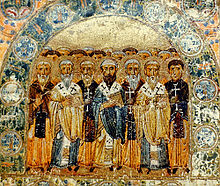
A trouble facing theologians wishing to maintain Mary's life-long virginity is that the Pauline epistles, the four gospels, and the Acts of the Apostles, all mention the brothers (adelphoi) of Jesus, with Marking and Matthew recording their names and Mark adding unnamed sisters.[15] [56] [Notes 1] The Gospel of James, followed a century later by Epiphanius, explained that the adelphoi are Joseph'south children by an earlier matrimony,[57] which is still the view of the Eastern Orthodox Christian churches.[58] Jerome, believing that Joseph, like Mary, must exist a life-long virgin,[59] argued that these adelphoi were the sons of "Mary, the mother of James and Joses" (Mk. 15:twoscore), who he identified with the wife of Clopas and sis of the virgin Mary (Jn 19:25),[58] which remains pop in the Western church building. A modern proposal considers these adelphoi sons of "Mary, the female parent of James and Joses" (non hither identified with the Virgin Mary's sis), and Clopas, who according to Hegesippus was Joseph'south blood brother.[58]
Further scriptural difficulties were added by Luke two:7, which calls Jesus the "first-born" son of Mary,[60] and Matthew ane:25, which adds that Joseph "did non know her until she had brought forth her firstborn son." [61] [Notes 2] Helvidius argued that beginning-born implies later births, and that the discussion "until" left open the manner to sexual relations after the birth; Jerome, replying that fifty-fifty an only son volition be a first-born and that "until" did not accept the meaning Helvidius construed for it, painted a repulsive give-and-take-portrait of Joseph having intercourse with a claret-stained and exhausted Mary immediately after she has given nascency - the implication, in his view, of Helvidius's arguments.[33] Opinions on the quality of Jerome'due south rebuttal range from the view that it was masterful and well-argued to thin, rhetorical and sometimes tasteless.[fourteen]
Ii other 4th century Fathers, Gregory of Nyssa, following "a sure apocryphal account," and Augustine, avant-garde a further statement by reading Luke one:34 equally a vow of perpetual virginity on Mary's part; this thought, starting time introduced in the Protoevangelium of James, has little scholarly back up today,[62] only it and the arguments advanced by Jerome and Ambrose were put forward past Pope John Paul Two in his catechesis of August 28, 1996, as the four facts supporting the Catholic Church building'southward ongoing faith in Mary's perpetual virginity.[63]
Come across also [edit]
- Anglican Marian theology
- Antidicomarians
- Assumption of Mary
- Cosmic Mariology
- Immaculate Conception
- Lutheran Mariology
- New Eve
- Panachranta (icon)
- Virgin birth of Jesus
Notes [edit]
- ^ Mark half dozen:3 names James, Joses, Judas, Simon; Matthew 13:55 has Joseph for Joses, the latter being an abbreviated class of the former, and reverses the social club of the last 2; Mark half-dozen:3 and Matthew 12:46 refer to unnamed sisters; Luke, John and Acts all mention brothers also. See Bauckham (2015) in bibliography, pages 6-nine.
- ^ The phrase "did not know her" is a biblical euphemism for sexual relations (see Gen 4:1). The text neither confirms nor denies the perpetual virginity of Mary, and there is no implication almost what happened after Jesus' conception and birth. See Harrington (1991) in bibliography, folio 36 footnote 25
References [edit]
"Against Heresies 3.21.4". New Appearance. c. 180. Retrieved 2021-12-30 . To this effect they testify, [saying,] that before Joseph had come together with Mary, while she therefore remained in virginity, she was institute with child of the Holy Ghost; Matthew 1:eighteen and that the angel Gabriel said to her, The Holy Ghost shall come up upon yous, and the power of the Highest shall overshadow yous; therefore besides that holy thing which shall be built-in of yous shall be called the Son of God; Luke ane:35 and that the angel said to Joseph in a dream, Now this was washed, that information technology might be fulfilled which was spoken by Isaiah the prophet, Behold, a virgin shall be with child. Matthew 1:23
"Against Heresies 3.21.10". New Advent. c. 180. Retrieved 2021-12-thirty . And as the protoplast himself Adam, had his substance from untilled and every bit even so virgin soil (for God had not nevertheless sent rain, and human had not tilled the footing Genesis ii:v), and was formed by the hand of God, that is, by the Discussion of God, for all things were fabricated by Him, John ane:3 and the Lord took dust from the earth and formed man; and then did He who is the Word, recapitulating Adam in Himself, rightly receive a birth, enabling Him to gather up Adam [into Himself], from Mary, who was as yet a virgin.
Citations [edit]
- ^ Hesemann 2016, p. unpaginated.
- ^ a b Collinge 2012, p. 133.
- ^ Bromiley 1995, p. 269.
- ^ "THE 2d HELVETIC CONFESSION". www.ccel.org . Retrieved 2021-12-21 .
- ^ Alexander, Joseph Addison (1863). The Gospel According to Marking. C. Scribner.
- ^ The American Lutheran, Volume 49. American Lutheran Publicity Bureau. 1966. p. 16.
While the perpetual virginity of Mary is held as a pious stance by many Lutheran confessors, it is non regarded as a binding instruction of the Scriptures.
- ^ The New Encyclopaedia Britannica, Book 11. Encyclopaedia Britannica. 1983. p. 562. ISBN978-0-85229-400-0.
Partly because of these biblical bug, the doctrine of the perpetual virginity of Mary has not been supported every bit unanimously as has the doctrine of the virginal conception or championship mother of God. It achieved dogmatic status, however, at the Council of Chalcedon in 451 and is therefore bounden upon Eastern Orthodox and Roman Catholic believers; in addition, information technology is maintained by many Anglican, some Lutheran, and a few other Protestant theologians.
- ^ Losch 2008, p. 283.
- ^ Shenouda III; Malaty, Tadros. "Lecture I: St. Mary's Perpetual Virginity & Immaculate Conception" (PDF). Diocese of the Southern United states. Retrieved 27 April 2022.
- ^ a b Fairbairn 2002, p. 100.
- ^ a b Campbell 1996, p. 150.
- ^ a b Lohse 1966, p. 200.
- ^ a b Rahner 1975, p. 896.
- ^ a b c d Polcar 2016, p. 186.
- ^ a b Maunder 2019, p. 28.
- ^ Parmentier 1999, p. 550.
- ^ Cross & Livingstone 2005, p. 237-238.
- ^ Boisclair 2007, p. 1465.
- ^ Hurtado 2005, p. 448.
- ^ Bell 2012, p. 110.
- ^ George-Tvrtkovic 2018, p. unpaginated.
- ^ Марчев, Радостин. Belief in the perpetual virginity of Mary in the first four centuries and its implications for Orthodox-Protestant dialogue.
- ^ Wirth 2016, p. 167-168.
- ^ Wirth 2016, p. 167.
- ^ "Philip Schaff: History of the Christian Church, Volume III: Nicene and Postal service-Nicene Christianity. A.D. 311-600 - Christian Classics Ethereal Library". world wide web.ccel.org . Retrieved 2022-02-x .
- ^ Tenney, Merrill C. (2010-08-10). The Zondervan Encyclopedia of the Bible, Book 1: Revised Full-Color Edition. Zondervan Academic. ISBN978-0-310-87696-0.
- ^ Stephen J. Shoemaker, "Epiphanius of Salamis, the Kollyridians, and the Early Dormition Narratives: The Cult of the Virgin in the 4th Century", Journal of Early Christian Studies, Vol. 16, No. three (2008), pp. 371–401. doi:10.1353/earl.0.0185
- ^ William H. Brackney, Historical Lexicon of Radical Christianity (Scarecrow Press, 2012 [ISBN 978-0-8108-7179-3]), p. 31.
- ^ Hunter 2008, p. 412.
- ^ Hunter 2008, p. 412-413.
- ^ Nathan 2018, p. 230.
- ^ Hunter 1999, p. 423-424.
- ^ a b Polcar 2016, p. 185.
- ^ a b Hunter 1993, p. 56-57.
- ^ Hunter 1993, p. 57.
- ^ Hunter 1993, p. 59.
- ^ Rosenberg 2018, p. unpaginated.
- ^ "Bonosus and the Bonosians". world wide web.ccel.org . Retrieved 2022-02-11 .
- ^ Catholic ENCYCLOPEDIA: Bonosus
- ^ Nathan 2018, p. 229.
- ^ Miller-McLemore 2002, p. 100-101.
- ^ Miller-McLemore 2002, p. 100.
- ^ Pelikan 1971, p. 339.
- ^ Gill 2004, p. 1254.
- ^ a b Litfin, Bryan (2015-01-16). Afterward Acts: Exploring the Lives and Legends of the Apostles. Moody Publishers. ISBN978-0-8024-9206-7.
- ^ Divozzo, R. (2019-06-12). Mary for Protestants: A Catholic's Reflection on the Meaning of Mary the Mother of God. Wipf and Stock Publishers. ISBN978-one-5326-7585-0.
- ^ MacCulloch 2016, p. 51-52,64.
- ^ Campbell 1996, p. 47,150.
- ^ McGuckin 2010, p. unpaginated.
- ^ Greene-McCreight 2005, p. 485.
- ^ Miravalle 2006, p. 56.
- ^ Dodds 2004, p. 94.
- ^ Miravalle 2006, p. 61-62.
- ^ Fahlbusch 1999, p. 404.
- ^ Miravalle 2006, p. 59.
- ^ Bauckham 2015, p. 6-8.
- ^ Nicklas 2011, p. 2100.
- ^ a b c Cantankerous & Livingstone 2005, p. 238.
- ^ Kelly 1975, p. 106.
- ^ Pelikan 2014, p. 160.
- ^ Harrington 1991, p. 36 fn.25.
- ^ Brownish 1978, p. 278-279.
- ^ Calkins 2008, p. 308-310.
Bibliography [edit]
- Bauckham, Richard (2015). Jude and the Relatives of Jesus in the Early Church. Bloomsbury. ISBN9781474230476.
- Bell, Richard (2012). The Origin of Islam in Its Christian Environs. Routledge. ISBN9781136260674.
- Blomberg, Craig (2006). From Pentecost to Patmos: An Introduction to Acts Through Revelation. B&H Publishing. ISBN9780805432480.
- Boisclair, Regina A. (2007). "Virginity of Mary (Biblical Theology)". In Espín, Orlando O.; Nickoloff, James B. (eds.). An Introductory Dictionary of Theology and Religious Studies. Liturgical Press. ISBN9780814658567.
- Booton, Diane E. (2004). "Variations on a Limbourg Theme". In DuBruck, Edelgard Eastward.; Gusick, Barbara I. (eds.). Fifteenth Century Studies. Vol. 29. Camden House. ISBN9781571132963.
- Boring, M. Eugene (2006). Marker: A Commentary. Presbyterian Publishing. ISBN9780664221072.
- Boring, Yard. Eugene; Craddock, Fred B. (2009). The People'due south New Attestation Commentary. Westminster John Knox. ISBN9780664235925.
- Bromiley, Geoffrey W. (1995). The International Standard Bible Encyclopedia. Eerdmans. ISBN9780802837851.
- Brown, Raymond Edward (1978). Mary in the New Testament. Paulist Press. ISBN9780809121687.
- Bruner, Frederick (2004). Matthew 1-12. Eerdmans. ISBN9780802811189.
- Burkett, Delbert (2019). An Introduction to the New Attestation and the Origins of Christianity. Cambridge University Printing. ISBN9781107172784.
- Calkins, Arthur Burton, Msgr. (2008). "Our Lady's Perpetual Virginity". In Miravalle, Mark I. (ed.). Mariology: A Guide for Priests, Deacons, Seminarians, and Consecrated Persons. Seat of Wisdom Books. ISBN9781579183554.
- Campbell, Ted (1996). Christian Confessions: A Historical Introduction. Westminster John Knox Press. ISBN9780664256500.
- Collinge, William J. (2012). Historical Dictionary of Catholicism. Scarecrow Press. ISBN9780810879799.
- Cantankerous, Frank Leslie; Livingstone, Elizabeth A. (2005). "Brethren of the Lord". The Oxford Dictionary of the Christian Church building. Oxford Academy Printing. ISBN9780192802903.
- Davids, Peter H. (2000). "Brothers of the Lord". In Freedman, David Noel; Myers, Allen C. (eds.). Eerdmans Lexicon of the Bible. Eerdmans. ISBN9789053565032.
- Dodds, Michael J. (2004). "The Education of Thomas Aquinas on the Mysteries of the Life of Christ". In Weinandy, Thomas Gerard; Keating, Daniel; Yocum, John (eds.). Aquinas on Doctrine:: A Disquisitional Introduction. A&C Black. ISBN9780567084118.
- Fairbairn, Donald (2002). Eastern Orthodoxy Through Western Eyes. Westminster John Knox. ISBN9780664224974.
- Fahlbusch, Erwin (1999). "Mariology". In Fahlbusch, Erwin; Bromiley, Geoffrey William (eds.). The Encyclopedia of Christianity, Book 3. Eerdmans. ISBN9780802824158.
- Fredriksen, Paula (2008). From Jesus to Christ: The Origins of the New Testament Images of Jesus. Yale University Press. ISBN978-0300164107.
- George-Tvrtkovic, Rita (2018). Christians, Muslims, and Mary: A History. Paulist Press. ISBN9781587686764.
- Gill, Sean (2004). "Mary". In Hillerbrand, Hans J. (ed.). Encyclopedia of Protestantism. Routledge. ISBN9781135960285.
- Greene-McCreight, Kathryn (2005). "Mary". In Vanhoozer, Kevin J. (ed.). Lexicon for Theological Interpretation of the Bible. Bakery Academic. ISBN9780801026942.
- Harrington, Daniel J. (1991). The Gospel of Matthew. Liturgical Printing. ISBN9780814658031.
- Hesemann, Michael (2016). Mary of Nazareth: History, Archaeology, Legends. Ignatius Press. ISBN9781681497372.
- Hunt, Emily J. (2003). Christianity in the Second Century: The Case of Tatian. Routledge. ISBN9781134409891.
- Hunter, David G. (2008). "Marriage, early Christian". In Benedetto, Robert; Knuckles, James O. (eds.). The New Westminster Dictionary of Church building History: The early, medieval, and Reformation eras. Westminster John Knox Printing. ISBN9780664224165.
- Hunter, David G. (1999). "Helvidius". In Fitzgerald, Allan D. (ed.). Augustine Through the Ages. Eerdmans. ISBN9780802838438.
- Hunter, David G. (Leap 1993). "Helvidius, Jovinian, and the Virginity of Mary in Belatedly Fourth-Century Rome". Journal of Early Christian Studies. Johns Hopkins Academy Press. one (1): 47–71. doi:10.1353/earl.0.0147. S2CID 170719507. Retrieved 2016-08-30 .
- Hurtado, Larry (2005). Lord Jesus Christ: Devotion to Jesus in Primeval Christianity. Eerdmans. ISBN9780802831675.
- Hurtado, Larry (2011). Marker. Baker Books. ISBN9781441236586.
- Isaak, Jon 1000. (2011). New Testament Theology: Extending the Table. Wipf and Stock Publishers. ISBN9781556352935.
- Kelly, John Norman Dividson (1975). Jerome: His Life, Writings, and Controversies. Harper & Row. ISBN9780715607381.
- Lincoln, Andrew (2013). Born of a Virgin?. Eerdmans. ISBN978-0802869258.
- Lohse, Bernhard (1966). A Brusque History of Christian Doctrine. Fortress Printing. ISBN9781451404234.
- Losch, Richard (2008). All the People in the Bible. Eerdmans. ISBN9780802824547.
- MacCulloch, Diarmaid (2004). Reformation: Europe's House Divided 1490-1700. Penguin UK. ISBN9780141926605.
- MacCulloch, Diarmaid (2016). All Things Fabricated New: The Reformation and Its Legacy. Oxford University Press. ISBN9780190616816.
- Maunder, Chris (2019). "Mary and the Gospel Narratives". In Maunder, Chris (ed.). The Oxford Handbook of Mary. Oxford University Press. ISBN9780198792550.
- McGuckin, John Anthony (2010). The Orthodox Church: An Introduction to Its History, Doctrine, and Spiritual Culture. Wiley. ISBN9781444393835.
- Migliore, Daniel L. (2002). "Woman of Faith". In Gaventa, Beverly Roberts; Rigby, Cynthia L. (eds.). Blessed Ane: Protestant Perspectives on Mary. Westminster John Knox Press. ISBN9780664224387.
- Miravalle, Mark I. (2006). Introduction to Mary: The Middle of Marian Doctrine and Devotion. Queenship Publishing. ISBN9781882972067.
- Miller-McLemore, Bonnie J. (2002). ""Pondering All These Things"". In Gaventa, Beverly Roberts; Rigby, Cynthia L. (eds.). Blessed Ane: Protestant Perspectives on Mary. Westminster John Knox Printing. ISBN9780664224387.
- Nathan, Geoffrey (2018). "The Jovinianist Controversy and Mary Aeiparthenos: Questioning Mary's Virginity and the Question of Motherhood". Saeculum. 68 (ii): 225–236. doi:10.7788/saec.2018.68.2.225. JSTOR 27638435. S2CID 201446177.
- Nicklas, Tobias (2011). "Traditions Near Jesus in Counterfeit Gospels". In Holmén, Tom; Porter, Stanley E. (eds.). Handbook for the Study of the Historical Jesus. BRILL. ISBN978-9004163720.
- Parmentier, Martin F.Grand. (1999). "Mary". In Van Der Toorn, Karel; Becking, Bob; Van der Horst, Pieter Willem (eds.). Dictionary of Deities and Demons in the Bible. Eerdmans. ISBN9780802824912.
- Pelikan, Jaroslav (1971). The Christian Tradition: A History of the Development of Doctrine. Vol. four: Reformation of Church and Dogma. University of Chicago Press. ISBN9780226653778.
- Pelikan, Jaroslav (2014). The Melody of Theology. Wipf and Stock. ISBN9781625646453.
- Polcar, Philip (2016). "Developments in the Doctrine of Mary'south Perpetual Virginity in Antiquity (second-7th centuries AD)". In Curta, Florin; Holt, Andrew (eds.). Great Events in Faith: An Encyclopedia of Pivotal Events in Religious History: vol.1. ABC-CLIO. ISBN9781610695664.
- Pomplun, Trent (2008). "Mary". In Buckley, James J.; Bauerschmidt, Frederick C.; Pomplun, Trent (eds.). The Blackwell Companion to Catholicism. John Wiley & Sons. ISBN9780470751336.
- Rahner, Karl (1975). Encyclopedia of Theology: A Concise Sacramentum Mundi. A&C Black. ISBN9780860120063.
- Rampton, Martha (2008). "Mary". In Smith, Bonnie Thou. (ed.). The Oxford Encyclopedia of Women in Globe History. Oxford University Press. p. 191. ISBN978-0-19-514890-9.
- Rausch, Thomas P. (2016). Systematic Theology: A Roman Catholic Approach. Liturgical Press. ISBN9780814683453.
- Reddish, Mitchell (2011). An Introduction to The Gospels. Abingdon Press. ISBN9781426750083.
- Rosenberg, Michael (2018). Signs of Virginity: Testing Virgins and Making Men in Late Antiquity. Oxford University Printing. ISBN9780190845919.
- Salisbury, Joyce East. (2004). "Jerome, Saint". In Kleinhenz, Christopher (ed.). Medieval Italy: An Encyclopedia. Routledge. ISBN9781135948801.
- Schumaker, John F. (1992). Religion and Mental Wellness. Oxford Academy Press. ISBN9780195361490.
- Stowasser, Barbara Freyer (1996). Women in the Qur'an, Traditions, and Interpretation. Oxford University Printing. ISBN9780199761838.
- Tilley, Maureen A. (1995). "One Woman's Body: Repression and Expression in the Passio Perpetuae". In Phan, Peter C. (ed.). Ethnicity, Nationality and Religious Feel. Academy Press of America. ISBN9780819195241.
- Vuong, Lily C. (2019). The Protevangelium of James. Wipf and Stock Publishers. ISBN9781532656170.
- Wiesner-Hanks, Merry (2005). Christianity and Sexuality in the Early Modern World: Regulating Desire, Reforming Practice. Routledge. ISBN9781134761210.
- Wheeler-Reed, David (2017). Regulating Sex in the Roman Empire: Ideology, the Bible, and the Early on Christians. Yale University Press. ISBN9780300231311.
- Wirth, Douglas (2016). Shivering Babe, Glorious Lord: The Nativity Stories in Christian Tradition. WestBow Press. ISBN9781512738711.
- Wright, David F. (1992). "Mary". In McKim, Donald Yard.; Wright, David F. (eds.). Encyclopedia of the Reformed Faith. Westminster John Knox Press. ISBN9780664218829.
- Zervos, George T. (2019). The Protevangelium of James: Greek Text, English Translation, Critical Introduction. Vol. 1. Bloomsbury Publishing. ISBN9780567689757.
Source: https://en.wikipedia.org/wiki/Perpetual_virginity_of_Mary
0 Response to "Sister Mary the Born Again Virgin"
Post a Comment